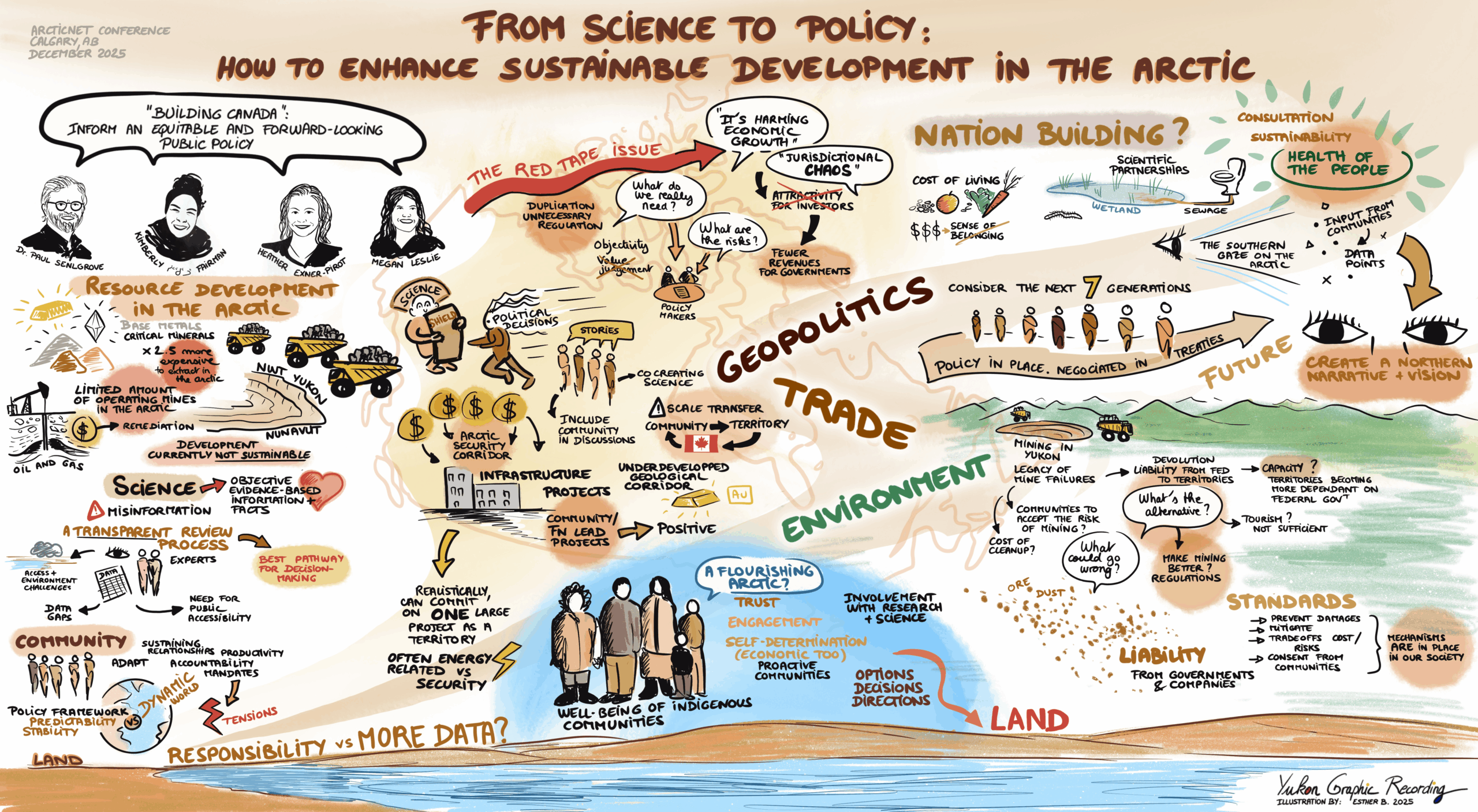
2025 Annual Scientific Meeting - graphic recording Artist
Throughout ArcticNet’s 2025 Annual Scientific Meeting, we had the pleasure of hosting three deeply insightful and engaging plenary sessions. Each hosted and moderated by highly qualified personnel exploring a range of topics from policy development, research, Arctic science, and knowledge transfer.
New to this year, ArcticNet hosted graphic recording artist Esther Bordet of Yukon Graphic Recording to help illustrate and disseminate the insightful information shared throughout the plenaries in an accessible and innovative way.
Decoding the Arctic: Genomics in a Changing World
(Click the photo to enlarge)
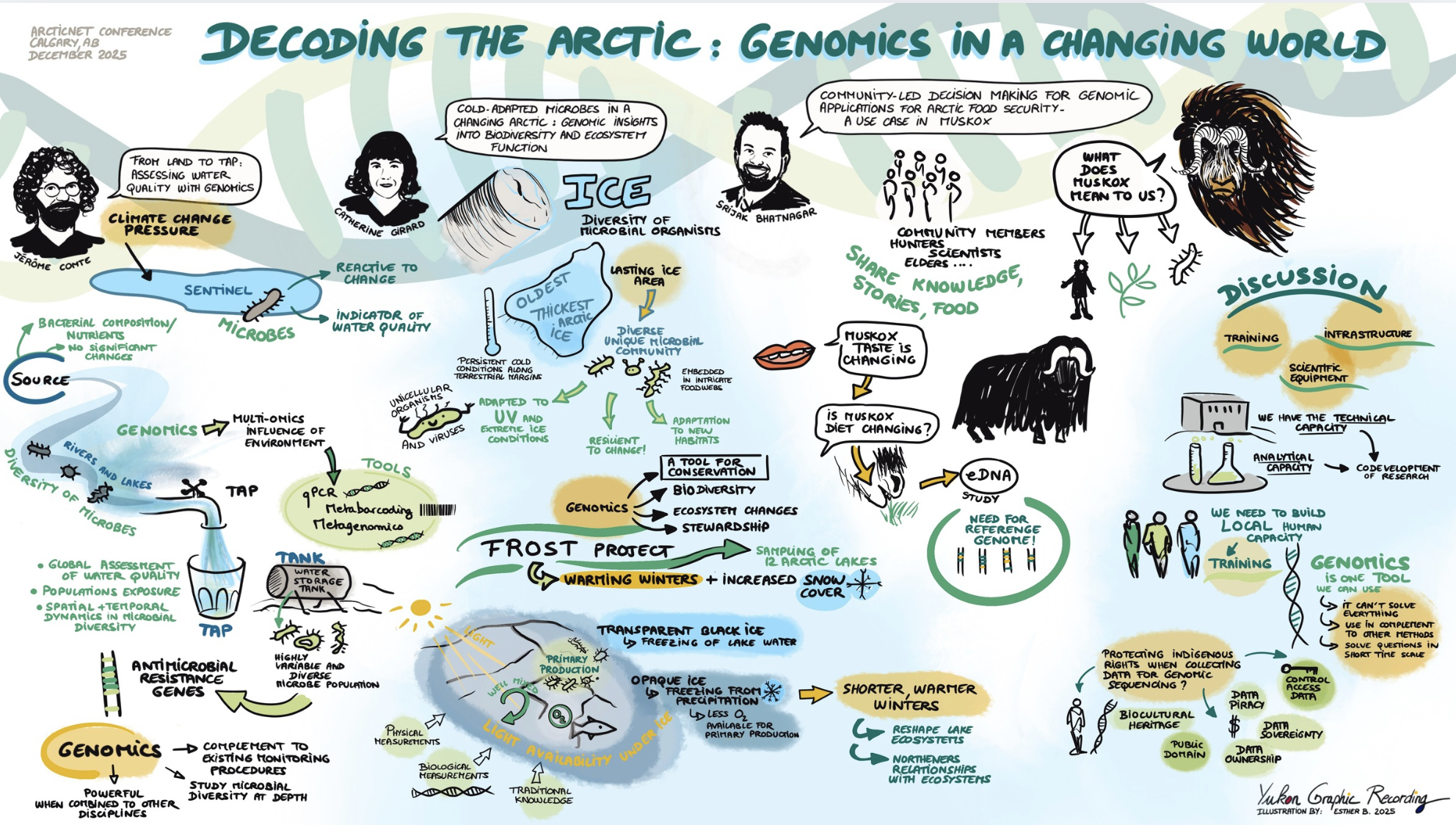
Moderated by Maribeth Murray (Arctic Institute of North America, University of Calgary) on the first day of ArcticNet’s 2025 ASM, December 15, 2025, the session opened with an introduction highlighting the topic of the plenary: genomics.
As expressed by our panellists Jérôme Comte (Institut national de la recherche scientifique), Catherine Girard (Université Laval), and Srijak Bhatnagar (Athabasca University), genomics is not just one tool, but instead it is a large variety of tools. Genomics is the study of the complete set of an organism’s DNA or genes (the genome). This can also include the study of the interactions of those genes with each other, as well as their interactions with the environment. Genomics can be applied to people, animals, and even water, as we discovered throughout this plenary session.
Jérôme Comte expanded upon his research, showcasing how genomics has provided a way to assess the quality of drinking water in Nunavik communities. By using genomics, we are given a sense of when people more often get sick from poorer water quality and where the source of bacteria could possibly be (and at what source, the water tank or the tap). Genomics gives us the tools to find out more information to support the health of the communities of Nunavik and beyond.
Further, Catherine Girard highlighted how genomics allows us to do critical work not just in the lab, but also in the field. It allows us to investigate deeper; however, it also complements what is already in place. Catherine is participating in work being conducted in the “Lasting Ice Area”, located in northern Canada and the Greenland territories, where the oldest ice in the Arctic is. With the changing climate, we see more white ice over black ice. Black ice is considerably stronger for different infrastructure needs. What does this change mean for communities and organisms? Using genomics to uncover this can support human sciences as well as traditional knowledge.
Srijak Bhatnagar also emphasized that genomics can support Arctic food security efforts. Genomics can help us to better understand biodiversity, which, in terms of the needs of Arctic communities, can further help us to understand what communities we are missing.
Bhatnagar focused on the case of the muskox. Traditional knowledge complements genomics, as Inuit Elders share the changes they have seen in plants and animals over their lives. In the case of the muskox, the animal’s diet is changing, with some community members noting it is eating more bark than before. Is that because of climate change? Genomics can help us to find out.
From Science to Policy: How to Enhance Sustainable Development in the Canadian Arctic